

CBAM Verification Support for Indian Exporters: How Eligible MSMEs Can Reduce Compliance Costs Through TRACE
Good News for Indian MSME Exporters
If your company exports to Europe or plans to export to Europe in the coming years, Carbon Border Adjustment Mechanism (CBAM) compliance is no longer a future discussion. It is rapidly becoming a market-entry requirement for many products entering the European Union.
The good news is that eligible MSMEs can now explore reimbursement support under the Government of India’s TRACE initiative for certain eligible Verification, testing, inspection, certification, audit, traceability and compliance activities that support international market access requirements.
For many exporters, this can substantially reduce the financial burden associated with CBAM verification and other regulatory compliance requirements.
What Is TRACE?
TRACE stands for: Trade Regulations, Accreditation & Compliance Enablement
It has been launched under the Export Promotion Mission (EPM) to help MSMEs participate more effectively in international value chains.
The objective is simple: Indian MSMEs should not lose export opportunities merely because compliance and certification costs are expensive
The scheme supports expenditure incurred towards:
- Testing
- Inspection
- Certification
- Audits
- Traceability systems
- Market-access compliance requirements
- International conformity assessment activities
required by foreign markets
Why CBAM Matters to Indian Exporters
The European Union’s CBAM requires importers to report and eventually account for the carbon emissions associated with imported goods.
As a result, exporters increasingly need:
- Emissions data
- Product-level carbon calculations
- Verification of reported information
- Independent third-party assessment
- Audit trails
- Traceability records
Without credible verification, European customers may face difficulties in fulfilling their own CBAM obligations.
Increasingly, buyers are asking suppliers:
- Can you provide verified emissions information?
- Have your emissions calculations been independently verified?
- Can your data withstand an accredited CBAM Verification?
This is where CBAM verification becomes important.
Which Sectors Should Immediately Pay Attention?
The strongest relevance currently exists for exporters involved in:
Metal & Engineering
- Aluminum
- Steel
- Iron products
- Fabricated metal products
- Castings
- Forgings
- Engineering components
Energy-Intensive Manufacturing
- Cement
- Fertilisers
- Hydrogen
- Industrial gases
Automotive Supply Chain
- Tier-1 suppliers
- Tier-2 suppliers
- Component manufacturers
- Metal processing companies
Electrical & Industrial Equipment
- Heavy machinery
- Capital equipment
- Industrial systems
Future Supply Chain Participants
Even if you are not directly exporting CBAM goods today, you may supply:
- Steel processors
- Automotive manufacturers
- Fabricators
- Export houses
- European OEM supply chains
Many companies will soon be asked to provide product-carbon information by customers further upstream.
Why Exporters Should Start Now
A common misconception is:
“We don’t export to Europe today, so CBAM is not relevant.”
Unfortunately, that assumption can become expensive.
When a buyer suddenly asks for:
- Carbon data
- Verification records
- Process traceability
- Supplier reporting
the exporter may have only a few weeks to respond.
The companies that start preparation early generally experience:
- Faster customer approvals
- Smoother onboarding with EU buyers
- Better supplier ranking
- Reduced future compliance pressure
- Faster market access
How Government Support Has Improved
The revised TRACE framework introduced significant improvements.
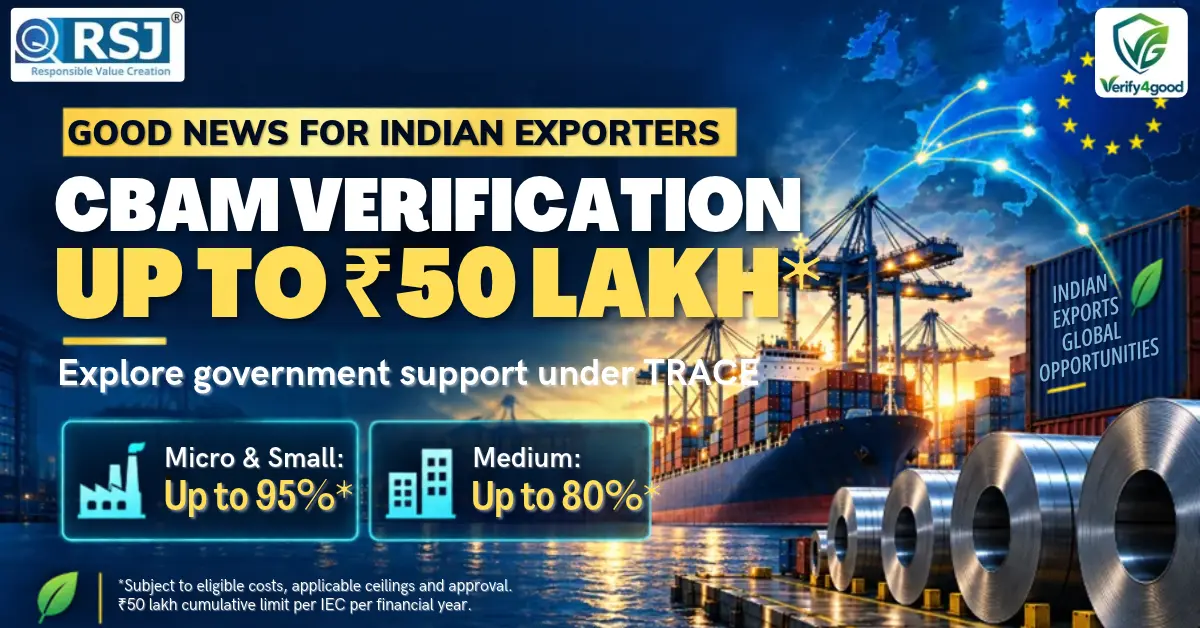
Micro & Small Enterprises – Up to 95% reimbursement of eligible costs.
Medium Enterprises – Up to 80% reimbursement of eligible costs.
Maximum Support – Up to ₹50 lakh per IEC per financial year. (Cases beyond ₹50 lakh may be considered separately after examination by the relevant authorities. )
Example: Understanding the Financial Impact
Assume: Eligible verification expenditure = ₹52 lakh
If the exporter qualifies under applicable TRACE provisions:
Potential eligible support may reach a substantial percentage of approved costs, subject to scheme rules, eligibility, ceilings and final approval.
For many exporters, this can dramatically reduce the effective cost burden of compliance activities.
How the Two-Stage Reimbursement Works
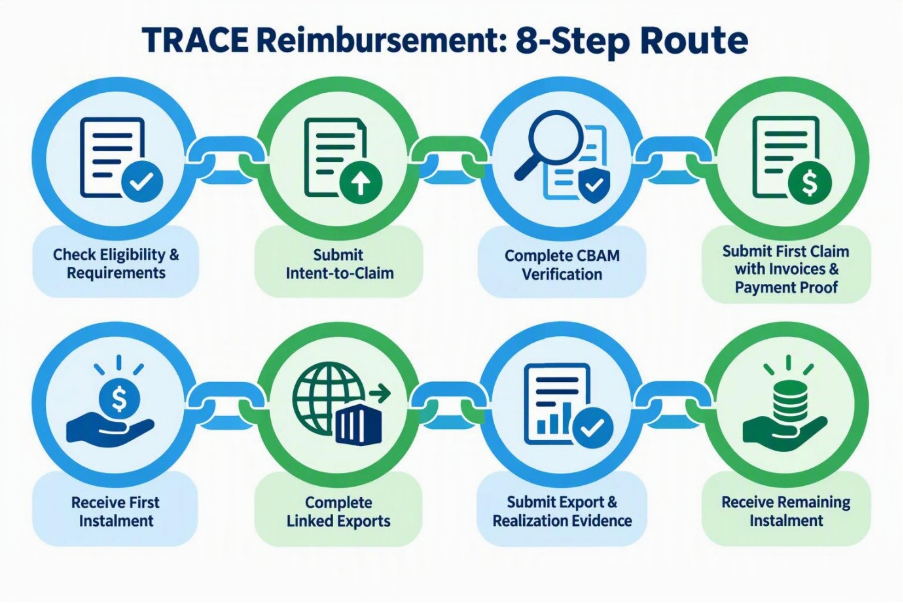
The revised framework introduced a two-instalment reimbursement structure.
First Instalment
After:
- Completion of verification/certification
- Submission of required documents
- Successful claim processing
50% of approved support may be released.
Second Instalment
After:
- Demonstrating exports linked to the certification
- Submission of export evidence
- Submission of realization evidence
remaining approved support may be released.
This model encourages actual utilisation of certifications for international trade.
Step-by-Step Route an Exporter Typically Follows
What Basic Eligibility Should an MSME Have?
Generally, applicants should have:
- ✅ Active IEC
- ✅ Valid Udyam Registration
- ✅ Export involvement through international value chains
- ✅ Compliance activity undertaken after applicable notification dates
- ✅ Supporting invoices and payment records
- ✅ No double-benefit claim under another scheme for the same expenditure
Information Typically Required During ITC (Intent-to-Claim) [Part A, B , C and Declaration]
Exporters should be prepared with:
1. ITC Part A – Basic Details
- Claim Year
- IEC Number (Auto-populated from IEC; non-editable)
- Firm Name
- Type of Exporter (Auto-populated from IEC; non-editable)
- MSME/Non-MSME (Auto-populated from IEC; non-editable)
- Type of MSME (Auto-populated from IEC; non-editable)
- ITC-HS Code (Only for Merchant Exporters)
2. ITC Part B – Testing, Certifications and Inspection Details
- Sector
- Certification Name
- Priority Certification (Auto-populated; non-editable)
- Certifying Agency
- Certifying Agency Address
- Purpose for obtaining certification
- Country of Export
- Amount (exclusive of taxes)- INR
- Amount (inclusive of taxes)- INR
- Total Intended Amount
3. ITC Part C – Other Compliance Related Information
- Type of Certification
- Nature of Certification
- Frequency of Renewal
- Are accredited labs in India adequate for your product certification?
- Testing period
4. Declaration
Having this information ready can streamline application submission.
Documents Typically Required During Reimbursement Claim Form (RCF) [Part A, B , C, D, E and Declaration]
Exporters should maintain:
- Part A – Application Reference
- IEC Number (auto populated)
- Application / UIN Number
- Date of Approval
- Part B – Claim Details
- Certification / Compliance Completed
- Name of Issuing Authority
- Date(s) of Certification / Testing / Audit
- Export Market(s) Covered
- Part C – Expenditure Details
| Sl. No. | Nature of Expenditure | Amount Incurred (₹) | Amount Claimed (₹) |
- Total Expenditure Incurred (₹)
- Total Reimbursement Claimed (₹)
- Part D – Documents Upload
- Proof of Certification / Compliance
- Invoices / Receipts
- Proof of Payment
- Any Other Supporting Document (if applicable)
- Part E – Bank Details (Auto-populated from IEC)
- Declaration
Why Documentation Discipline Matters
Many reimbursement applications are delayed because:
- Documents were misplaced
- Payment proofs were incomplete
- Verification reports were not preserved
- Export linkage could not be established
A structured compliance file should be maintained from the beginning of the project.
Where RSJ Inspection Can Help
CBAM verification is not only about calculations.
Exporters often need support understanding:
- Verification requirements
- Evidence requirements
- Audit readiness
- Verification planning
- Documentation expectations
- Sector-specific obligations
RSJ Inspection works with industries that increasingly face international compliance requirements and can support exporters in understanding CBAM verification pathways and preparing for verification activities.
If your organization exports to Europe, plans to enter the European market, or supplies exporters that serve European customers, now is the right time to start the CBAM verification conversation.
Sectors That Should Immediately Connect With RSJ
- Steel manufacturers
- Aluminium producers
- Metal fabricators
- Foundries
- Engineering companies
- Auto-component manufacturers
- Process industries
- Industrial product exporters
- Building-material manufacturers
- Supply-chain partners supporting EU exports
The Bigger Question: How Do You Actually Claim This Support?
Reading about support of up to ₹50 lakh naturally leads to another question:
How does an exporter actually apply for reimbursement under TRACE?
Many businesses are surprised to learn that reimbursement is not simply about completing CBAM verification.
The process contains:
- Intent-to-Claim submission
- Portal-based applications
- Supporting documentation
- Verification records
- Invoices and payment proofs
- Export evidence
- Realisation evidence
- Multiple claim stages
Missing a step or maintaining incomplete records can affect the claim journey.
It is therefore important to understand the process before starting CBAM verification activities.
In our next article, we’ll break down the complete reimbursement process, including where exporters apply, what information needs to be submitted, which documents should be kept ready, timelines to watch for, and common mistakes that can delay claims.
Final Thought
For many Indian exporters, CBAM is often viewed only as a compliance requirement.
However, the latest TRACE framework creates an opportunity to reduce the financial burden associated with eligible verification activities while simultaneously preparing for future European market requirements.
The companies that start preparing today will generally be better positioned to:
- Respond to buyer requirements faster
- Build confidence with international customers
- Maintain documentation from the beginning
- Explore available support opportunities under TRACE
And once you’re ready to move forward, the next question becomes important: How do you actually claim the support?
That’s exactly what we’ll cover in our next article:
“How to Claim TRACE Support for CBAM Verification: Step-by-Step Guide for Indian Exporters”
If your organisation exports to Europe, plans to enter European markets, or supplies companies serving European buyers, now is the right time to start the CBAM verification conversation.
Connect with RSJ Inspection to discuss your CBAM verification requirements, expected documentation, and verification readiness

Get Started Today
Are you ready to take the next step in managing your organization’s GHG emissions? Whether you’re looking to assess your carbon footprint, verify your GHG inventory, or gain third-party assurance, our expert team is here to help